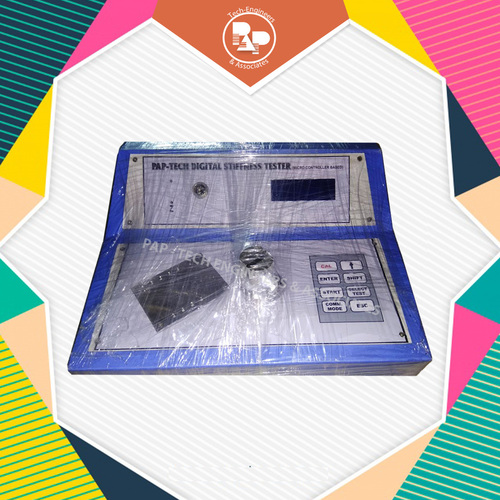
About Digital Paper Stiffness Tester (Bending Type)
Product Details:
| Minimum Order Quantity | 1 Piece |
| Display Type | Digital |
| Measuring Range | 0-5000 mN |
| Accuracy | +/-2% |
| Type | Bending |
It is provided with imported load cell from SWEDA Sweden.
As per TAPPIT- 543.
Advanced Precision for Accurate Stiffness MeasurementEquipped with a high-precision load cell from SWEDA Sweden, the Digital Paper Stiffness Tester ensures reliable and reproducible results within a 1% accuracy level. Suitable for both paper and thin film, it delivers test results quickly through a digital LED display, making it essential for quality control in paper and packaging industries.
Flexible Testing with User-Friendly ControlsFrom programmable test angles up to 90 to selectable measurement units, users can easily customize tests to fit their requirements. With a digital keypad interface, automatic reset, and both calibration modes, the device is intuitive to operate and suitable for routine and complex testing alike.
Compliant and Robust Design for Industrial EnvironmentsHoused in powder-coated MS steel, this tester combines durability with advanced safety features such as overload protection. It meets international standards (TAPPI T556, ISO 5628), operates within a wide range of humidity and temperature, and comes complete with calibration weights and an operation manual for seamless setup and maintenance.
FAQ's of Digital Paper Stiffness Tester (Bending Type):
Q: How do I operate the Digital Paper Stiffness Tester?
A: To operate the device, place a single specimen (paper, cardboard, or thin film) in the standard specimen port. Select your desired unit (mN or gf) and test angle (up to 90) using the digital keypad. Initiate the test; results will be displayed on the LED screen in less than 2 seconds.
Q: What materials can be measured with this tester?
A: This device is designed for assessing the stiffness of paper, cardboard, and thin film materials, accommodating specimens up to 38 mm in width. Its test range supports a broad variety of industrial and laboratory applications.
Q: When should calibration be performed on the tester?
A: Calibration is recommended before initial use and at regular intervals depending on your laboratory's protocol. The tester supports both automatic and manual calibration, using the included calibration weights, to ensure accuracy and compliance with TAPPI and ISO standards.
Q: Where can this tester be installed and operated?
A: This is a tabletop device suitable for indoor laboratory and industrial environments. It operates optimally at temperatures from 10C to 40C and relative humidity between 20% and 90%.
Q: What is the procedure for exporting or storing test data?
A: Test data can be transferred via the RS232 serial port for integration with laboratory information systems or external storage. The device's built-in memory can retain results from up to 100 tests for review and record-keeping.
Q: How does the tester ensure user safety during operation?
A: The instrument features overload protection, shielding the load cell and internal components during testing. The powder-coated steel body also enhances the overall safety and durability of the unit during regular lab use.
Q: What are the benefits of using this digital tester in a laboratory?
A: The tester offers rapid, accurate measurement with digital control and automatic reset, reducing operator error and increasing throughput. Compliance with international standards and memory storage improve traceability and product quality assurance.


 Opening Hours - Mon to Sat: 9 AM to 7PM
  Call Us : 08045477961







 Send Inquiry

 Send Inquiry
 Send Inquiry
 Send SMS
 Call Me Free